
Virginia Deeds by Instrument Type
A Virginia circuit clerk indexes deeds alongside many other land-record instruments. Not every document in the index conveys ownership. A routine conveyance, a debt instrument, and a paper restricting how land can be used each answer a different question, even when all three sit in the same local index.
| Deed Type | What It Does | Common Use |
|---|---|---|
| Bargain-and-sale deed | Conveys the interest stated in the instrument; read its warranty language. | Sale or other transfer of land. |
| Deed of gift | Records a transfer that may have no ordinary sale consideration. | Family or estate-related transfer. |
| Quitclaim deed | Releases the grantor's stated interest without proving the grantor held the whole parcel. | Clearing or changing a claimed interest. |
| Trustee, executor, or administrator deed | Records a transfer made by a fiduciary or trustee. | Estate, court, or foreclosure process. |
| Correction deed | Repairs or clarifies an earlier recorded description or instrument. | Correcting a prior deed reference or legal description. |
| Deed of trust | Creates security for a debt; it is not an everyday sale to the lender. | Financing, followed by assignments or a release. |
Easements, covenants, leases, plats, rights-of-way, and declarations also shape a property's record trail, though they may never change the tax-roll owner. A name or sale-date hit alone proves little. To see which rights actually moved, open the deed image itself and trace any plats or prior recordings it cites.
Virginia Deeds in SRA/COVERS
The Virginia Courts SRA information page explains the remote-access route. From there, pick the county or independent city you need. SRA/COVERS is a doorway to records supplied by individual clerks. It is not one complete statewide land-record database. Each locality controls its own online index, document images, and legacy coverage.
The SRA/COVERS live portal makes the clerk-first step obvious. An index may be open to anyone. Images can be another matter. Opening them may require the clerk's authorization, a paid subscription, or a courthouse terminal. Check the locality's Available Courts entry. Note the oldest index year and oldest image year separately. Virginia publishes no single statewide cutoff year. A blank result therefore cannot prove an older deed never existed.
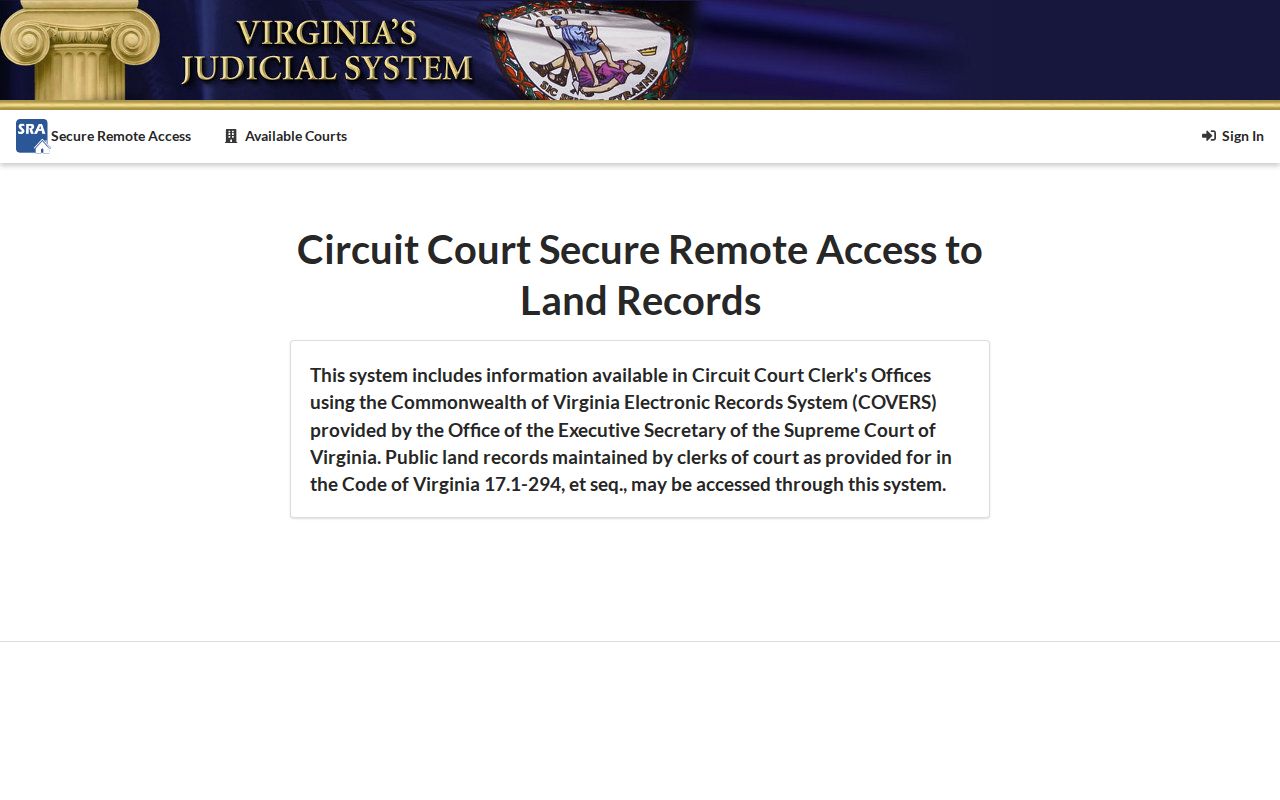
The statewide landing page lays out the access route. What you can actually reach, from loaded indexes to openable deed images, is decided by the local clerk you select.
Fields Found in a Virginia Deed Index
Search screens at Virginia's circuit court clerks show some blend of the fields listed here. Names for each option vary from one locality to the next. Older deed indexes may also follow a historical layout instead of the electronic arrangement used today, so expect differences when you move between counties.
| Search Field | What to Enter | Use and Limit |
|---|---|---|
| Locality or court | County or independent city | Required route to the correct clerk. |
| Grantor / party name | Prior owner, seller, trustee, or entity | Try role, spelling, initials, and suffix variants. |
| Grantee / party name | Buyer, present owner, trust, or business | Often starts a backward chain from a known deed. |
| Instrument type | Deed, deed of trust, release, plat, lien, or local code | Exact list is local; use it to narrow the record family. |
| Recording date | From and to dates | Narrows a large party-name result set. |
| Book/page or document number | Known legacy reference or instrument number | Direct lookup where that clerk supports it. |
| Parcel or tax-map ID | Local identifier, if indexed | Not guaranteed for older deeds or all local systems. |
A deed-index hit is a reference record. Common result details include:
| Result Detail | What May Appear | What to Confirm in the Instrument |
|---|---|---|
| Locality and parties | Circuit court, grantor, grantee, and indexed name form. | Correct jurisdiction, party role, spelling, and any trust or fiduciary capacity. |
| Instrument details | Document type, recording date, instrument date, and number or book/page. | Use the reference to open or request the full instrument. |
| Parcel and consideration | Parcel/tax-map ID or sale consideration when supplied. | Either may be absent from the index and appear only on the image. |
| Image access | Link, subscriber prompt, or local-terminal route. | Confirm access and inspect attachments, description, and any redactions. |
A typical result gives you the parties, the instrument type, the recording and instrument dates, and a book/page or document number. Other details stay inside the image. Consideration, the parcel ID, the full legal description, attachments, and marginal releases often appear only when you open the recorded deed. Use the index as a finding aid. Then compare every name against the original instrument before you rely on it.
Trace Virginia Deeds from Grantee to Grantor
A chain of title is the sequence of recorded transfers for one parcel. Building it means stepping backward. Begin with a recent conveyance you know. Then use each instrument's party names and prior deed reference to reach the one before it. The parcel's legal description anchors the chain more firmly than a modern street address. Addresses shift after subdivision or readdressing, but the description holds.
- Find the most recent deed into the owner shown by the local assessment card; use that owner as grantee.
- Open the deed and note the grantor, grantee, date, instrument number or book/page, parcel identifier, and legal description.
- Search the grantor as the next grantee to locate that party's acquisition, then compare the property description.
- Repeat until reaching the target period or the online record limit; continue with the clerk's indexes and books or LVA microfilm.
- Grantor
- The party conveying an interest in the instrument.
- Grantee
- The party receiving the interest stated in the instrument.
- Chain of title
- The ordered trail of deeds and related records for the land.
- Book/page or instrument number
- Local references that identify a recorded document; the format varies by clerk and era.
Try alternate spellings. Search initials, spouses, trustee or executor titles, and entity suffixes too. Parcel numbers can change after a split or merger, so keep the parent-parcel and plat references rather than trusting one current ID as permanent.
Virginia Index Versus Deed Image
The Supreme Court of Virginia's SRA guide describes how local circuit court clerks share records through one statewide service. An index line can be open to everyone. Its scanned deed image may not be. Virginia restricts some images to approved subscribers or to a terminal inside the clerk's office.
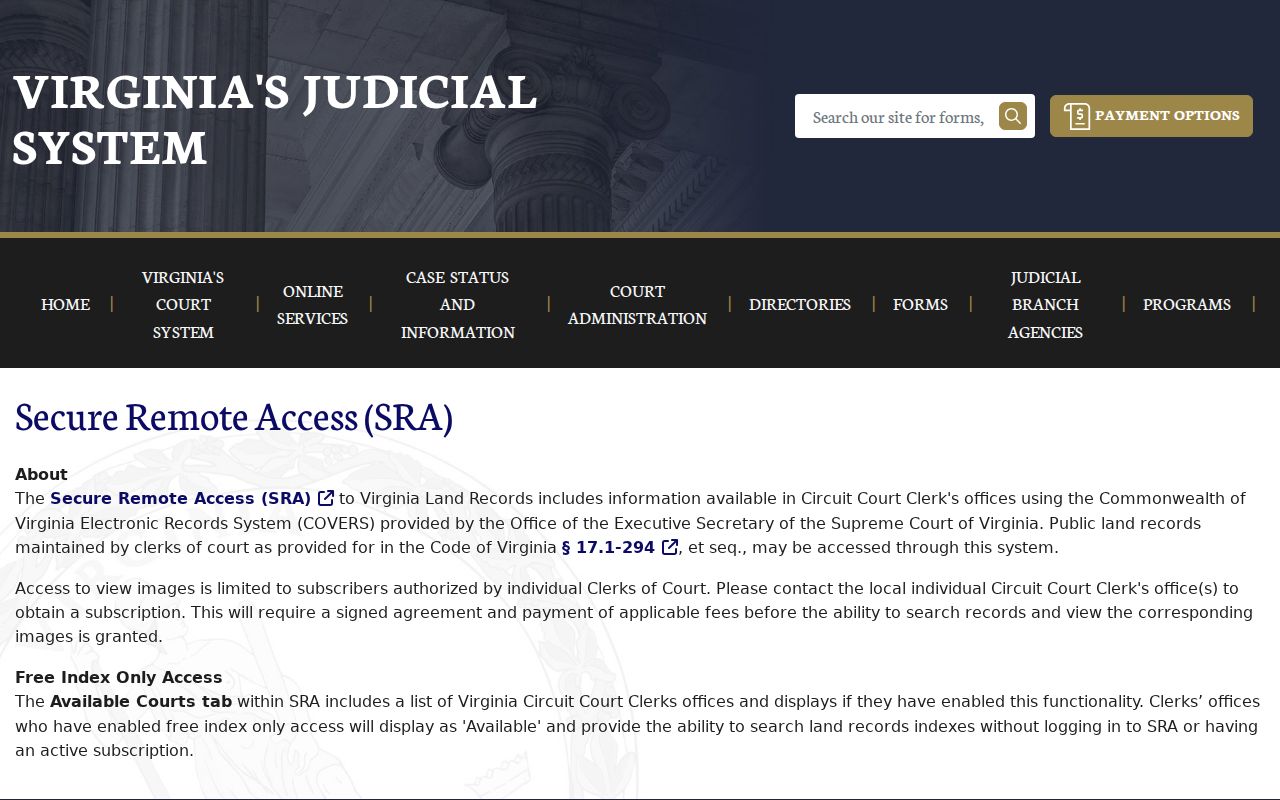
Pull the instrument reference from the index first. Then check the clerk's instructions for the image, a plain copy, or a certified copy. Access and charges vary by locality.
Request a Virginia Deed Image or Copy
When a remote image is out of reach, contact the circuit clerk directly. Ask about the public terminal. Ask about staff search help, older deed books on site, self-service photography rules, and copy options. Written requests move faster when they name key details. Give the locality, party names and their variants, and the instrument type. Add an approximate date, a parcel or tax-map ID, and any known instrument number or book and page. Say whether you need a plain or certified copy. Specify what the request covers. That may be the whole deed, a plat, an attachment, a release, or a marginal notation.
Copy requests follow the local clerk's procedure. Counter service, remote subscriptions, courthouse terminals, and mailed or electronic requests all work that way. The statewide fee schedule sets a $0.50-per-page reference for paper or electronic images. It allows up to $5 for digital certification. Remote subscriptions can run up to $50 a month. Extra clerk charges, payment methods, postage, plat reproduction, or recording fees can change the total. Check the clerk's current schedule rather than assuming one statewide price.
Recorded is not the same as verified title. An index proves that a reference was recorded in that system; it does not resolve every ownership claim or establish that no unrecorded or later-challenged interest exists. For a legal title question, rely on a qualified title review and the custodian's actual instrument.
Older Virginia Deed Books and Local Archives
When a clerk's online deed index runs dry, the answer is usually a local paper or microfilm index. The Library of Virginia county and city microfilm guide catalogs deed-book and general-index reels locality by locality. Each reel may sit at LVA. It may circulate by interlibrary loan, or exist only in the local clerk's office. Know which before you plan a trip. For a title dispute built on older records, pair the search with the Chancery Records Index. Chancery cases often hold testimony, maps, partitions, and exhibits. These can explain a broken chain of title when the deed books alone cannot.
Call the clerk before traveling. Confirm which of the oldest deed books remain on site. Ask about the terminal hours, photography rules, and the copy process. Estate conveyances call for probate papers and wills; subdivisions call for plat books and recorded notices. LVA's catalog may point you to a reel. Even so, the deed book itself, or the clerk's official copy, remains the instrument a researcher should cite.
Virginia Deed Alerts
Some Virginia clerks offer VADeed Alert, a free and voluntary email notice. A newly recorded local land record triggers it. The match can be an enrolled name, tax-map number, or parcel ID. Treat it as an awareness tool only. It is not a title freeze. It is not an identity check or a legal ruling of any kind. Availability varies by clerk. Any alert should send you back to the recorded deed itself, the real instrument.
Virginia's 2025 deed-fraud study names a practical limit on what clerks can do. Clerks generally record documents that appear to meet filing requirements. They do not judge authenticity at the counter. A 2026 Library of Virginia preservation-grant round continues funding scanning and indexing work. Access should improve over time. But legacy deed indexes and images stay local for now. If a filing looks unfamiliar, keep the notice and instrument details. Then contact the clerk and the right legal or law-enforcement resource.
The City of Staunton's VADeed Alert notice describes the alert example and its limits. A different county or independent city may run another system. Some may offer no alert service yet.