
Virginia Assessed, Market, and Sale Values
Virginia's commissioner or assessor keeps the local land book. That office assigns each parcel an assessed fair-market value on the tax roll. A private appraisal and a deed price come from elsewhere. One property can therefore carry several numbers, close together or far apart, set on different dates by different custodians.
| Value type | What the number describes | Record custodian |
|---|---|---|
| Assessed value | The locality's land-book assessment, set as fair market value under Virginia's real-property assessment framework | Local commissioner of the revenue or assessor |
| Market value | An estimate of likely market worth on a stated date; a separate appraisal is prepared for a specific appraisal purpose | Licensed appraiser for an appraisal; the assessor maintains the local assessment estimate |
| Last sale price | The consideration or price associated with a recorded transfer, if available in the deed or local sales history | Circuit court clerk for the recorded deed; local assessor may display a sale reference |
Virginia law asks for a fair-market assessment. The land-book number is still tied to the locality's valuation process and date. It promises no current market price. The state assessment/sales-ratio study measures locality-level assessments against bona fide sales; it does not convert one home's assessment into a current asking price.
Virginia's January 1 Property Assessment Date
The local land book names the owner chargeable on January 1. It also carries that year's real-estate assessment. A sale recorded after that date can leave the deed newer than the name. That name sits on the current assessment card. That gap is a timing rule. It is not a promise about when a locality refreshes its website or updates an owner field.
Virginia Code § 58.1-3281 sets the annual land-book framework and the January 1 date. Compare values with care. Save both the assessment year and the deed recording reference when you compare property records. A later transfer does not prove the prior assessment wrong. It may simply describe a different date and purpose.
Read a Virginia Property Assessment Card
Virginia's 133 local tax authorities share no single statewide screen, field set, or label scheme. Cards differ by locality. Labels rarely match across jurisdictions. When a public card is available, note the locality, parcel key, page date, valuation year, and exact value labels. Some cards separate land from improvements. Others list a total fair-market assessment or a taxable amount after a special assessment. Never treat a missing field as zero; note instead that the card does not display it.
Owner labels vary too. A card may say Owner, Taxpayer, Assessed To, or Owner of Record. Copy that wording exactly. A taxpayer field guarantees no legal title. The commissioner or assessor maintains the land book, while the treasurer receives the charge and handles the bill. For questions beyond the number, Virginia Tax's locality resources point to local assessment contacts.
If no public card is online, contact the local commissioner or assessor by phone or at the office. Give the locality, parcel ID, and land-book year. Ask for the card by email. Request a cost estimate first. An existing administrative record can be requested under Virginia FOIA, while deeds kept by a circuit clerk follow separate court access and copy rules.
Find a Virginia Property Value by Address
Begin with the local assessment record. Its parcel card carries the assessed figure. A statewide comparison study is no substitute for that local card, and the statewide parcel layer is not an owner or value search. If an address will not resolve, confirm the governing county or independent city. Then try the local parcel or tax-map number.
- Identify the county or independent city that holds the land book, rather than relying on the mailing city or ZIP Code.
- Search the locality's assessor or commissioner portal by situs address; if available, use the parcel or tax-map number to confirm the match.
- Record land value, improvement value, total assessed value, valuation year, and any date or sales-history label shown.
- For the last transfer price, use the clerk's recorded deed or instrument reference and compare its date with the assessment date.
- Assessed value
- The locality's value entered in the land book for assessment purposes.
- Market value
- An estimate of exchange value on a date; an appraisal is a separate professional opinion for a stated purpose.
- Sale consideration
- The amount or consideration associated with a recorded transfer, which may need confirmation in the deed image.
- Assessment/sales ratio
- A comparison of assessed values to bona fide sales at the locality level, not a parcel-specific price multiplier.
The Virginia property search route can pinpoint your parcel.
Virginia Tax Studies Compare Locality Values
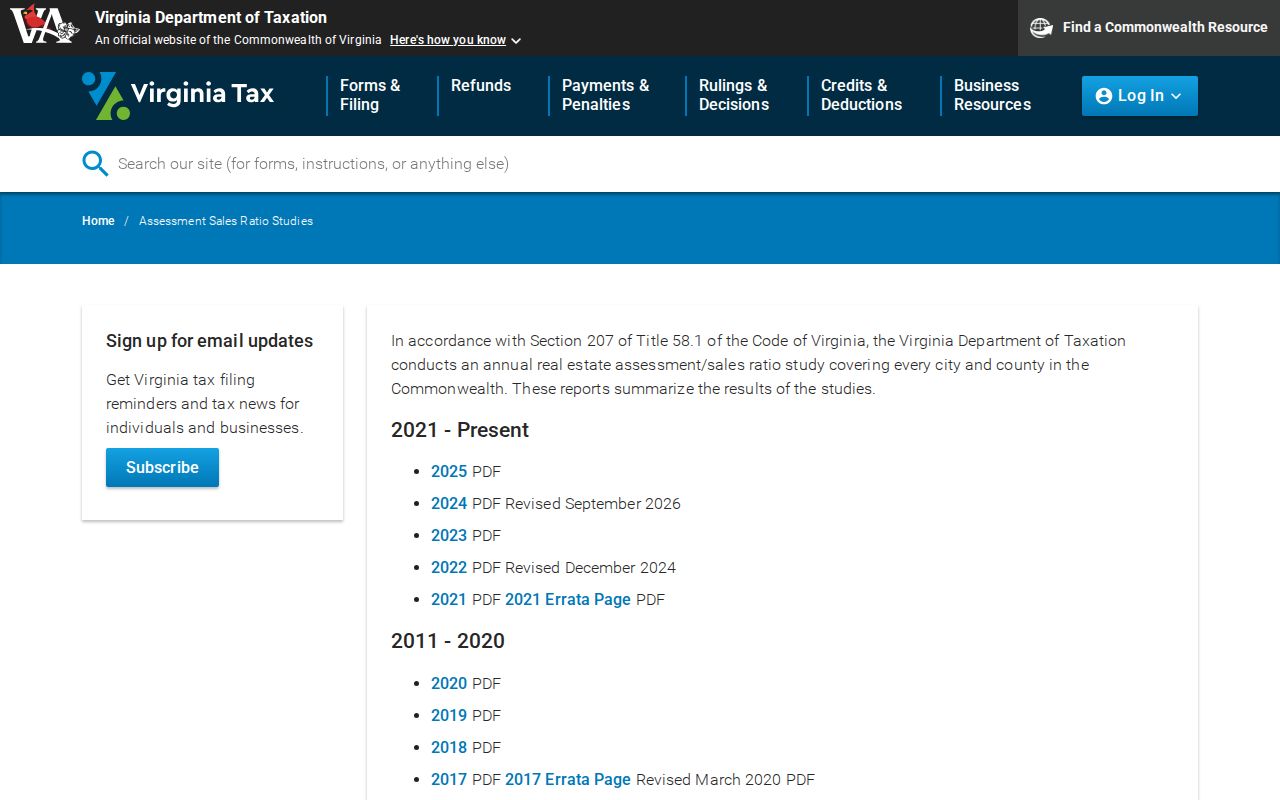
Virginia Tax publishes assessment/sales-ratio studies comparing localities' assessments with bona fide sales. Each study shows how a locality's assessed roll relates to its sale sample and where it sits in its own reassessment cycle. Ratios vary by locality and year. A study is no price estimate for a parcel. A statewide summary should not be squeezed into a single Virginia ratio.
The studies cover Virginia's 95 counties and 38 independent cities. Reassessment schedules range from annual to six-year cycles. So each locality's row and study year matter. The state page lists locality and year downloads, including revised 2024 study material plus 2025, 2024, and 2023 files; check the current study before quoting a cycle or result.
Open the official Virginia Tax assessment/sales-ratio studies page to choose a locality and study year. It is a comparison resource. It is not a property-level valuation card.
Use the studies to compare assessment practice across localities and years. Use the local assessment card for one parcel.
A Recorded Sale Gives Another Signal
A last-sale field offers a handy reference point. The assessor, though, may publish only some transfers, and the sales coding can be selective. The recorded deed remains the primary source for any transfer. Its index typically points to a book and page or an instrument number. The image itself carries the deed language and the legal description. It also shows the parties and any consideration shown. That is where the transfer story actually lives.
Assessment cards vary widely on sales history. Some show a sale date, price, deed reference, and a qualified-sale indicator. Others show only a fragment of that trail. A missing price field does not prove no transfer occurred. The locality may not publish consideration, or it may not count the sale as qualified. A gift deed, for example, records a transfer with no ordinary sale price. Compare the instrument type and the stated consideration before treating either figure as a market reference.
Timing matters too. Line up the deed date, the recording date, and the assessment date. Do this before setting a sale beside the current tax roll. A recent sale can land after the January 1 land-book date. An older purchase reflects an entirely different market period. Parcel splits and mergers add another wrinkle. The current assessment may cover land the sale instrument described differently. Read the numbers with that record trail intact.
The statewide SRA/COVERS land-record entry point routes searchers to participating local circuit clerk systems. Index availability, image access, and online coverage all vary by locality. When the instrument image is not online, use the clerk's terminal or request channel instead.
Virginia Property Value Reassessment Timing
Virginia localities reassess on their own calendars. The statewide comparison runs from annual cycles out to six-year schedules. That span shapes how far an assessment may sit from a recent sale. It does not mean a local card changes with every transfer. Nor does a statewide average describe one neighborhood.
For a parcel-level comparison, note the value year and the locality's stated reassessment date. Then check the relevant locality and year in Virginia Tax's study. When the public card omits its valuation date, ask the commissioner or assessor. Ask which land-book year the field reflects. Keep that answer attached to the figure rather than labeling it simply "current market value."
What a Virginia Property Assessment Cannot Show
A local assessed value is a mass-appraisal figure built for the assessment process. It cannot say what a buyer will pay for a specific property. It is not a sale appraisal. A licensed appraiser can prepare a market-value opinion for a stated purpose, using the property, the date, and the appraisal scope.
Value and price answer different questions. Virginia's assessed figure belongs to the local land book; the recorded consideration belongs to a transfer instrument. Neither one, by itself, is a current appraisal or a promise of a future sale price.
Assessment figures only tell part of the story. For the bill itself, payment history, and other tax-account records, take the separate Virginia property tax records route.