
What Virginia Property Tax Records Show
Virginia counts 95 counties and 38 independent cities. A property tax search often crosses two offices. The commissioner of the revenue or assessor keeps the land book. The treasurer bills and collects. Each locality maintains its own property records, so the table separates common fields by custodian, and no single statewide tax portal displays every parcel's assessment and bill.
| Field | What It Shows | Where |
|---|---|---|
| Assessed fair-market value | Local assessment used in the real-estate tax calculation; value year and parcel detail vary. | Commissioner or assessor. |
| Land and improvements | Separate land and building values when the local card displays them. | Commissioner or assessor. |
| Owner or taxpayer and mailing address | Name charged on the local roll and tax-bill address, which can differ from the situs. | Commissioner or assessor. |
| Exemptions and special assessment | Local relief or land-use treatment where the locality records it. | Commissioner or assessor. |
| Bill and payment status | Amount due, payments, delinquency, interest, penalties, or collection activity when offered. | Local treasurer. |
| Tax-sale record | Notice, sale status, redemption, or disposition if retained and published. | Local treasurer and related clerk file. |
Virginia assessment law follows a fair-market-value standard. That figure is not a sale price. It is not a private appraisal or a promise of what a buyer would pay. The treasurer applies the local rate and billing schedule. Before comparing figures, check the tax year and record date printed on each screen.
Find Virginia's Local Property Tax Tools
The Commonwealth offers no statewide parcel card or bill portal. Start with the governing county or independent city. Its commissioner or assessor holds the assessment. Its treasurer handles billing and payment status. Virginia Tax maintains a locality resource page with links and forms for local property-tax administration.
Treat that page as a route map. Its display helps locate local administration links, including land-use resources and Board of Equalization forms, but it cannot show any parcel's bill.
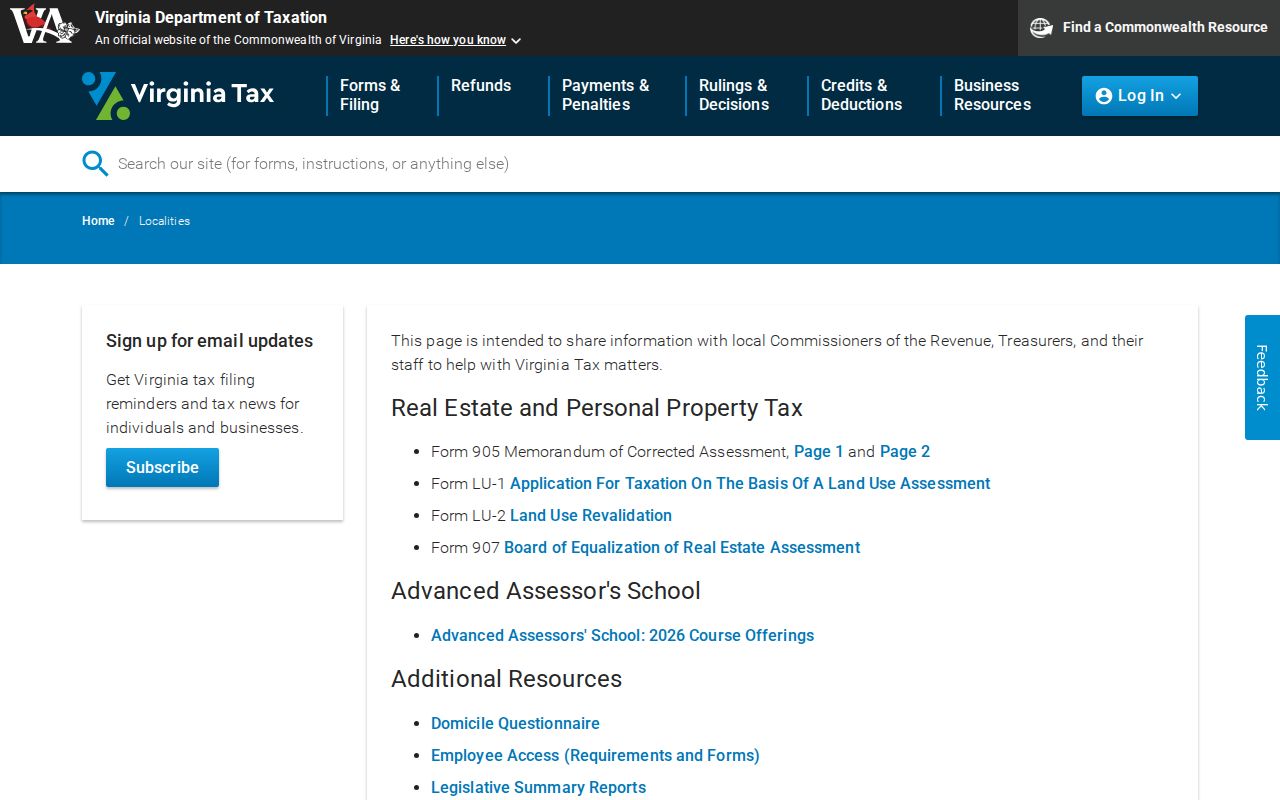
Follow the locality link to the office that owns the record. Then check that office's current portal and request steps. Links go stale. If a locality link is missing or a search page has moved, use the Virginia locality finder to confirm the governing county or independent city. Call or visit its assessment office or treasurer. Ask for the public property-search URL, the bill link, the current tax year, and the paper or electronic copy procedure.
Search Virginia Property Tax Assessment Fields
Local vendors build different forms, so an assessment search commonly offers only some of these fields. Options differ across Virginia systems. No county or city exposes every field.
| Field | Common Entry | What to Check |
|---|---|---|
| Owner name | Person, trust, estate, or business name | Exact or partial matching varies; preserve initials and suffixes. |
| Situs address | House number, street, direction, unit | Partial street search may not be offered. |
| Parcel, tax-map, or account number | Local identifier with its punctuation and leading zeros | No uniform Virginia format exists. |
| Subdivision or map/lot/block | Local neighborhood or lot key | Useful when addresses return multiple parcels. |
| Sales date or year | Date range or year, where supported | Not all local systems index sales history. |
Record the displayed fields and the data date.
| Result Card Detail | What It May Show | Reading Limit |
|---|---|---|
| Owner and addresses | Taxpayer/owner label, situs, mailing address, locality, and ZIP. | Copy the label as printed; situs and mailing address are different fields. |
| Parcel and description | Parcel/account key, legal description, subdivision, lot/block, or acreage. | IDs vary by locality and can change after a split or merger. |
| Assessment and relief | Land, improvement, total, taxable value, tax year, and exemption flags. | An absent flag means not displayed, not necessarily no relief. |
| Property characteristics | Use, year built, area, construction, sketch, or photo if offered. | These are assessment fields, not a survey or inspection. |
| Sales and links | Sale date, price, deed reference, GIS, bill, permit, or appeal links. | Verify any recorded transfer against the clerk's deed image. |
Copy the owner or taxpayer label exactly as displayed. Keep the situs address separate from the mailing address. Also hold onto the parcel key and the full legal description. If the screen omits a value, exemption, or sale field, note that it is not displayed rather than assuming it does not exist.
Look Up a Virginia Property Tax Bill
Start with the locality's treasurer or finance office. Search by parcel, tax account, or situs address where the system accepts it. Public bill tools vary widely. Some offer a searchable account, others publish lists or annual notices, and some require a call, a written request, or a counter visit. Assessment card and bill come from different offices.
- Confirm the correct locality and locate its official treasurer page through the local government site or Virginia Tax locality resources.
- Search by the local parcel or account number when known; otherwise try the situs address or owner field only if the local system supports it.
- Read the tax year, billed amount, payment history, and any delinquency, interest, or penalty label displayed.
- Compare the account with the assessor's parcel card and exemption or land-use status, then ask the treasurer about a missing year or tax-sale status.
- Assessed value
- The local fair-market assessment on the land book; it is not necessarily the same as taxable value after a local exemption or special assessment.
- Local rate or levy
- The locality's charge used to calculate the bill; check the official bill or rate sheet for its unit and period.
- Homestead exemption
- Do not assume a Virginia-wide homestead field or benefit. Relief and eligibility labels are local or tied to specific state-authorized programs.
- Tax lien
- A recorded or collection claim connected with unpaid taxes; verify the current balance and any release with the treasurer and clerk.
Virginia Tax Records: Assessor and Treasurer
The commissioner of the revenue or assessment office maintains the land book, assigns or displays the local parcel key, records the owner charged on January 1, and sets the assessed fair-market value. It may also apply local exemptions or special assessments and show a property-search card. Those fields describe the locality's tax roll; they do not establish a deed's complete ownership terms.
The treasurer receives the tax charge, applies the local rate and billing schedule, and records payments, interest, penalties, delinquency, and collection activity. Some treasurers provide a bill lookup, while others publish a PDF list or require a direct request. A recent deed can be ahead of the land book because the tax year charges the owner as of January 1 and local updates vary.
Virginia Tax does not publish a single parcel-level bill for every locality. If the public page is unavailable, call the relevant office and ask for the current parcel-card or tax-bill URL, the tax year shown, copy format, and any local charge. A locality's written reply is also useful when a web card lacks a needed tax year.
Virginia Property Tax Relief Varies Locally
Virginia assessment cards can carry many kinds of relief. Look for land-use treatment, conservation status, or veteran and surviving-spouse relief on the parcel card. Senior or disabled relief may appear too, along with charitable or religious classification. The labels, records, and filing routes all vary. Virginia sets no common statewide homestead exemption field. So a blank label proves nothing about eligibility. Start with the locality's commissioner or assessor, and ask which application fits the parcel, which assessment years it covers, what evidence is required, and whether an annual renewal applies.
Virginia Tax's locality page links land-use materials and Board of Equalization forms. Form 907 handles review of a real-estate assessment. Still, the locality's own instructions control where and how you file. Keep the application and outcome with your parcel records. An exemption can lower taxable value without touching the fair-market assessment, the recorded deed, or the treasurer's payment history.
Virginia Property Tax Reassessment Cycles and Ratios
Reassessment cycles in Virginia range from annual to every six years. That spread matters. A parcel's value can reflect a different assessment date than a neighboring locality's or a buyer's current offer. Check the locality's notice and assessment card. The card should state the tax year. Published cards may also give a valuation date.
The Virginia Department of Taxation's assessment/sales-ratio studies compare local assessments with bona fide sales across Virginia's counties and cities. A median ratio shows one thing. It measures assessment level since the last reassessment. Virginia Tax lists revised 2024 study material and recent annual downloads, so note the study year and revision date before comparing. Pair the study with the parcel card, since a ratio cannot explain a property's condition, improvements, exemption status, or recent transfer by itself.
Appeal a Virginia Property Tax Assessment
Assessment appeals in Virginia follow local instructions. Begin with the assessment notice. Confirm the tax year, the property identifier, the assessor's review procedure, and the deadline for an appeal to reach the locality. The route may run through the commissioner or assessor first, then the local Board of Equalization if needed. Skip any assumed statewide filing date. Confirm the current window and submission method.
Virginia Tax lists Board of Equalization forms, including Form 907 for real-estate assessment review. Ask the local board or assessment office whether to file Form 907, where it goes, and what papers are accepted. Ask how a hearing works. A further review path may exist, and copies of the notice, application, parcel card, and any written response are worth keeping.
Check the local deadline first. Virginia has no one appeal date for every county and independent city. Use the deadline and instructions on the locality's notice or confirm them with the assessor and Board of Equalization before sending Form 907.
Virginia Delinquent Tax Records
Virginia has no statewide parcel-delinquency portal. Local practice fills the gap. A treasurer may post a searchable list, publish a PDF or annual notice, or require an in-person request. Search the locality's official site for "delinquent real estate," "tax sale," "judicial sale," or "land sale." Then verify current status with the treasurer. A newspaper notice shows publication only. One label is not a history.
Build a dated trail instead of treating a single "delinquent" tag as the present condition. Note the tax year and bill status, the first notice date, any recorded lien or lis pendens, the advertised sale, postponement or cancellation, redemption status, and final disposition. Title may not have changed. If it did, confirm a recorded trustee or commissioner deed, court confirmation, or later conveyance before calling the transfer complete.
A portal search can come up empty. Ask the treasurer for the tax year and parcel ID, whether older payment or sale lists are retained, and how to get the bill or status record. A specific written FOIA request works better. Name the locality, parcel, record series, and years. State the preferred format too. Virginia FOIA allows actual, reasonable costs for search, review, copying, conversion, and postage. A deposit may apply above $200. Court records held by a clerk follow court-access rules, not the general FOIA process.
Court-supervised sales raise other questions. The Virginia Courts case-information portal can help locate a case, though there is no statewide civil circuit-case search. Use the local circuit clerk directory to request a docket or file. Give the party name, case number, filing year, case type, and property description. Ask about archived papers, exhibits, maps, and certified orders. A missing web result proves nothing.
For an official summary of the request process, see the Virginia Freedom of Information Act. The five-working-day response framework, and any permitted extension, binds the public body rather than a courthouse clerk acting as custodian of court records.