
Virginia's Current Owner Record
The local assessment card pairs a name with the parcel the locality taxes. Its fields are not identical statewide. Some vendors leave information out. Read the exact labels and the date before treating any result as the current owner of record.
| Owner Name | The person or entity shown on the local roll, under that locality's label. |
|---|---|
| Mailing address | The destination for tax notices or correspondence; it may not be the property's location. |
| Situs | The physical address attached to the parcel, if one is assigned or displayed. |
| Last sale date | A locality sales-history field when published; check its deed reference. |
| Deed reference | Book/page or instrument number linking to a recorded conveyance, when the card includes it. |
A tax-roll field names the taxpayer, not every form of title. The entry might list one person, joint owners, an LLC, a trustee, or an estate. A blank last-sale field is not proof that no transfer occurred. The locality may simply withhold sales history. Or its property records may key the parcel differently, so the field stays empty even when a deed exists.
Read Virginia's Tax-Roll Owner
Local offices run the land book. In Virginia, the commissioner of the revenue, the assessor, or a real-estate department keeps that roll, and no statewide property search card exists to standardize it. Field labels differ from one locality to the next. One screen says "Owner." Another says "Taxpayer," "Assessed To," or "Owner of Record." Copy the official label rather than upgrading it into a stronger legal claim.
The roll ties the name to a parcel key or account, the assessed value, and any exemption or special-assessment data shown locally. The treasurer is a separate job. That office handles bills, payment history, delinquencies, and collections. A current bill and a current deed answer different questions, even where one site links to both property records.
- Owner of record
- The name shown by a specific record series for that record's purpose.
- Assessment roll
- The locality's land book that carries the parcel and the person or entity chargeable for assessment.
- Situs address
- The property's physical location, distinct from the address where notices are mailed.
- Mailing address
- The address used to deliver a tax bill or owner correspondence.
- Recording lag
- The interval between a deed appearing in clerk records and a local card reflecting its information.
Virginia Sets January 1 Assessment
Virginia fixes its assessment date at January 1. The real-estate assessment is set as of that day, and the owner chargeable on January 1 is the name tied to that tax year's roll. A deed recorded afterward can therefore sit atop the assessment card for a while. This is why two official property records can show different names without either screen being a data-entry mistake. The rule comes from Virginia Code § 58.1-3281. The land book itself stays local. No statewide web refresh date exists, and the statute does not force localities to post an immediate owner change after a closing.
For the lawful owner, the deed check still decides. Compare the latest recording against the roll's tax year and any "last updated" note. If a property changed hands near the annual assessment date, the newest recorded grantee is often the better present-tense clue. The older name on that year's tax record is not wrong. It is just dated.
Virginia Code § 58.1-3281 contains the assessment-date text here:
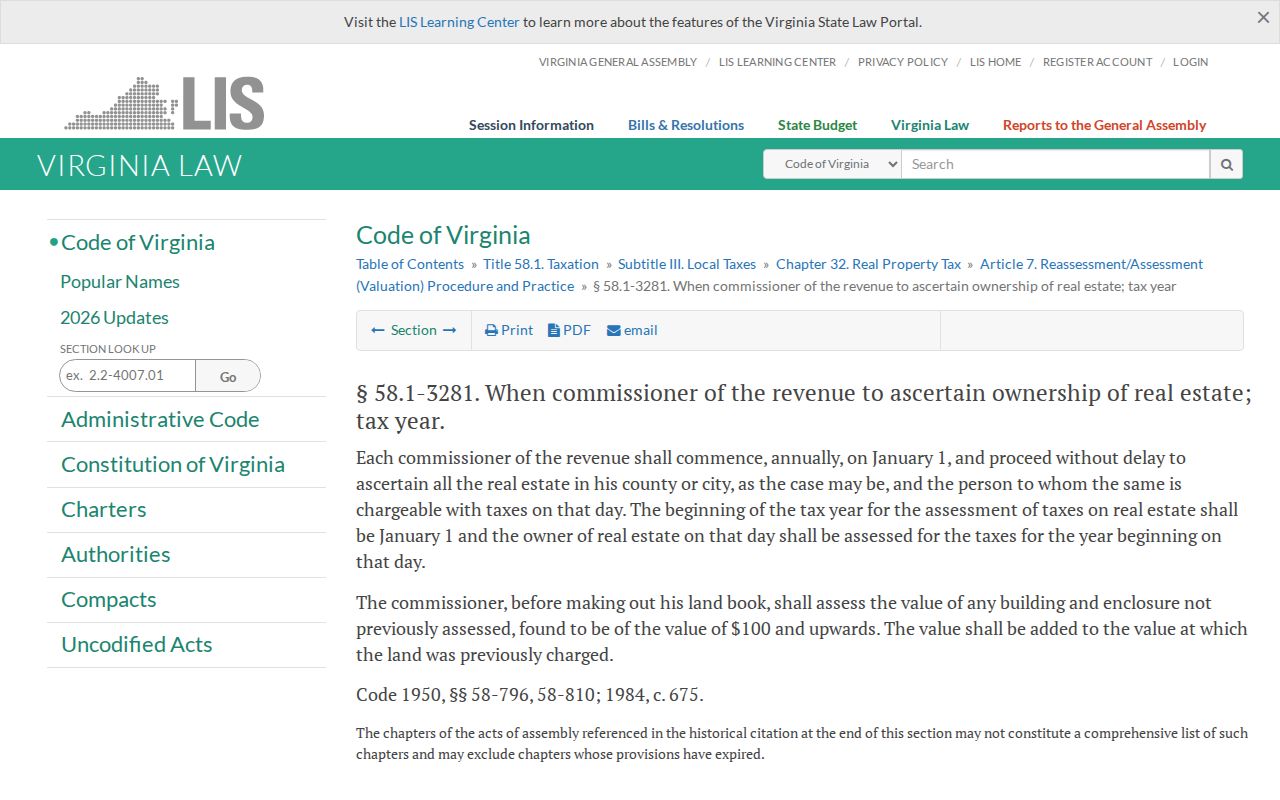
The date is a statewide anchor. Posting and refresh practice stays local, though, so check the assessor's card for the tax year shown on the current owner record.
Virginia Roll Updates Vary Locally
Virginia keeps no statewide average for how long a closing takes to reach an assessment card. The state's 95 counties and 38 independent cities keep separate land books. No single update schedule covers them all. So a neighbor locality's turnaround tells you nothing about yours.
Write down the card's tax year and update date. Then compare those with the deed recording date. If they disagree, call the local assessor. Ask when the current land book will reflect transfers. That office can also tell you how its public card updates. It may refresh continuously, on a set cycle, or by another process. The answer has to come from the locality, not from an assumed lag.
Checking online only? Save a dated printout or screenshot where that is allowed. If no card exists, request the specific parcel or account entry and tax year. Don't ask for everything on file about the property.
Confirm the Current Virginia Owner
Start with the assessment card to find the parcel. Then let the most recent deed be your confirmation point. Virginia's circuit clerk index is the bridge in the public record between a name on the tax roll and the instrument that conveys an interest.
- Copy the local owner or taxpayer field, parcel or tax-map ID, locality, and any deed reference.
- Select that locality in SRA/COVERS and find the latest deed indexed to the current grantee.
- Compare the parties, instrument date, recording date, and legal description or parcel references with the assessment card.
- If the online result has no image, ask the circuit clerk about a courthouse terminal, subscription route, or copy request.
An index entry may list party names, document type, dates, and a book/page or instrument number. Layouts differ by clerk. A record reference points you to the instrument; it never replaces reading the deed itself.
Virginia Entity and Trust Names
The owner of record listed on a deed is not always a person. It may be an LLC. It may be a corporation, a trust, an estate, or several co-owners sharing title. Match the exact grantee name from the deed to the name on the assessment card. Small differences creep in constantly. Name order shifts and punctuation varies. Entity suffixes, trustee wording, or an estate representative's title may render one owner two different ways across systems.
Virginia business entities get their own check. The SCC Clerk's Information System searches by entity name or ID. It returns status, principal office, registered agent or office, formation details, and filing history. Its dashboard covers activity from the December 2019 launch forward; older filings may sit elsewhere. One caution: a registered agent is a service contact. It is not proof of who personally owns anything.
Trusts and estates take separate digging. The circuit clerk's probate division can hold wills and qualification papers. It may also hold estate deeds and orders explaining a transfer. Watch the tax roll here too. It may name one taxpayer while the deed describes multiple interests.
Mailing Address Is Not Situs
Two address fields do two different jobs. The situs points to the land itself. The mailing address only routes bills and notices, and it may belong to the owner, an entity, a registered agent, an attorney, or a tax service. It can even sit outside Virginia. Treating it as the current owner's home takes independent, lawful support.
Copy both fields separately. Note where each came from. A USPS ZIP lookup can standardize the mail address, but a ZIP proves nothing about who is present at that location. If an address is protected through Virginia's Address Confidentiality Program, do not chase the actual location or repeat it from another record.
Some cards show no mailing address or last-sale date. Record "not displayed" and move on. Absence on one portal never proves the information is missing from the deed image or another locality system.
Virginia's VADeed Alert Service
Some clerks have enabled VADeed Alert. It is an email notice that fires when a filing matches a selected name or Tax Map/Parcel ID. Think of it as an early warning. It does not stop a filing, validate a deed, or replace pulling the official instrument. Availability depends on each clerk and the service setup.
Layer the alert on top of a completed lookup. Do this after the locality and parcel are already identified. A match still needs review for spelling, similar names, or a neighboring parcel. Follow the notice into the SRA/COVERS record, or contact the clerk for instrument details.
Remember what an alert is not. Alert access and owner information are different things. A notification proves neither that a transfer is valid nor that the assessment roll has updated yet. When resolving a discrepancy, keep the date and source of every result.
Protect a Virginia Owner's Address
Virginia's Address Confidentiality Program provides eligible survivors and household members a substitute address. The program also supplies mail forwarding. Public bodies generally accept the substitute. Records that would reveal a participant's actual location get statutory protection instead. A participant's real address should never be reconstructed from a mailing field. Nor should it be repeated in a property lookup.
Public-record access has other boundaries too. Social Security numbers, protected court data, and victim information all sit behind limits. Ask the custodian about redaction rather than hunting for a private address. If a public card looks wrong, the assessor's correction route is the fix. But removing a private-directory entry changes no official land book or recorded deed.
Virginia FOIA covers many administrative records. Court-clerk land records follow court access and copy procedures instead. Direct any request to the correct custodian. Identify the parcel, record series, date range, or instrument number.
A Virginia Record Is Not a Title Opinion
An assessor's owner field is a tax record, nothing more. A recorded deed proves only that an instrument was accepted into the land records. Neither resolves every lien or release on its own. Neither settles a later court action, an unrecorded claim, or a title defect. And an owner lookup never establishes who actually occupies the land.
Check the deed before relying on the roll. When the newest transfer matters, compare the assessment card with the latest recorded deed and its legal description. A property record is not a title search, legal opinion, or survey.
Need the broader route from name or address to official records? Use the Virginia property-owner lookup method. This page stays focused on the present roll entry and how its date compares with the latest instrument.